
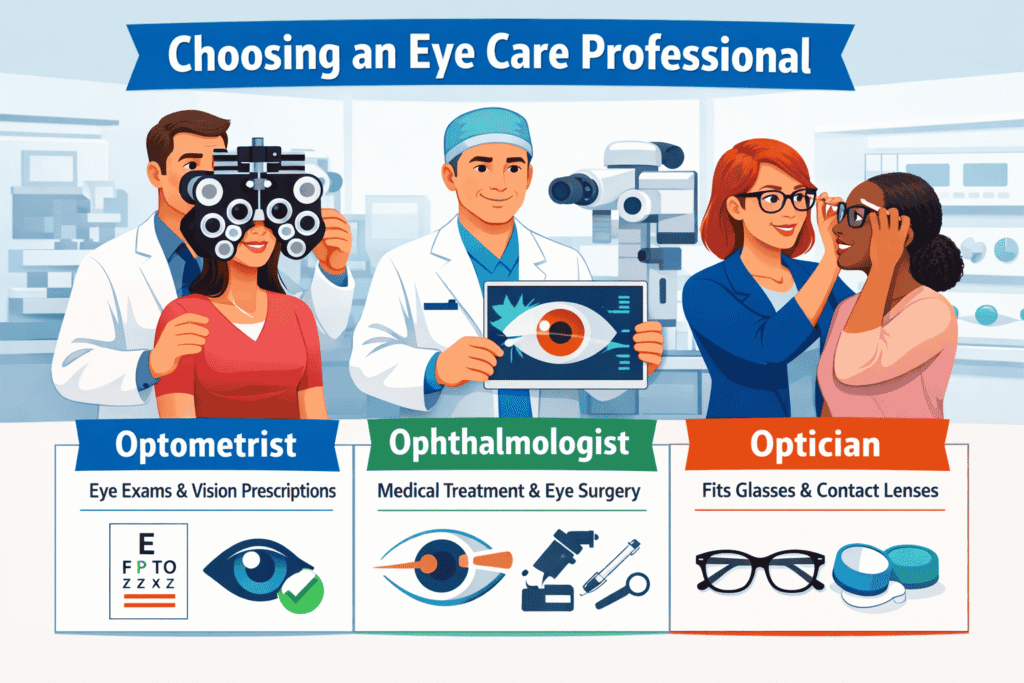
Optometrists, Ophthalmologists, and Opticians: What’s the Difference?
Optometrists provide regular eye health care. Opthalmologists, on the other hand, is focused on surgical treatments to treat eye problems and opticians help with fitting eyeglasses and other eye aids.
If you’ve needed to find an eye doctor you’ve probably heard that there are many kinds of specialists in the field. Optometrists, Ophthalmologists, and opticians are all specialists in the field of eye health.
We’ll look at the educational requirements, salary and scope of practice and the services that optometrists opticians, and ophthalmologists offer. We’ll also go over how to pick the most suitable optometrist for your requirements.
What is an optometrist?
An optometrist is the main medical professional in regular eye health.
Education level
The optometry postgraduate degree is a doctorate degree that is generally 4 years long to complete, based on the institution and curriculum. The program’s curriculum comprises:
- basic eye exam techniques and advanced
- Case history of the client and case studies
- Additional courses in the sciences of nature (including optics) and the study of pharmacology
The Optometry program also offers the opportunity to train as a resident that usually takes place in the last 1 to two years of the program however, it can also be started earlier. The duration and amount of the course and training is dependent on the school of optometry.
An optometry residency can be an additional option to get more knowledge in a particular subject, such as:
- Ocular diseases
- Contact lenses with specialization
- Pediatrics
- binocular vision
Salary range
in 2023 the median annual salary for optometrists was $131.860 a year according to the Bureau of Labor Statistics.
Services they offer
Visit an optometrist for your annual eye examination, to refill your eyeglass or prescription for contact lenses or even get treatments and medications for specific eye diseases.
In contrast to an ophthalmologist optometrist does not function as an expert in surgery and is not able to manage more difficult eye problems.
Optometrists can provide these services
- annual or routine eye exams, including eye health education
- The diagnosis of eye diseases
- prescriptions for:
- glasses
- contact lenses
- Other vision aids to vision
- Minor surgical procedures to treat eye issues
- postoperative eye treatment
Optometrists are able to prescribe controlled medications to treat eye issues. According to state laws certain optometrists may also do minor surgical procedures, like foreign body removal as well as the laser procedure for eye.
>>>MORE: Find an optometrist close to you.
What is an ophthalmologist?
Ophthalmologists are medical professional who is specialized in surgical procedures for the eye.
Education level
All doctors must complete an entire medical course and have a one-year experience prior to starting an three-year Ophthalmology residency. The program is based on:
- Treatment and diagnosis of both external and internal eye disorders of the eye
- Training for subspecialties in eye disease
- Ophthalmic surgical education for all kinds of eye diseases
Ophthalmology residency training also involves the hands-on care of patients, which involves operating surgical procedures under the supervision of a physician.
Similar to optometrists and optometrists. Ophthalmologists participate in an optional fellowship which usually lasts from one to two years. In this fellowship, ophthalmologists are trained in specific areas like:
- Oculoplastics
- glaucoma
- Pediatrics
- neuro-ophthalmology
- The cornea or retina, also known as the cornea or the retina
Salary range
The year 2023 the average wage for Ophthalmologists was $312,120 per year.
Services they offer
An ophthalmologist can be consulted to get the same services like an optometrist, for example, a routine eye exam or refill of your prescription. But, an ophthalmologist could do eye surgeries to treat various conditions and diseases such as cataracts Glaucoma as well as Strabismus.
Ophthalmologists can provide these services
- basic optometry services
- The treatment for surgical and medical eye ailments
- Rehabilitation after surgery for the eye
Based on the area of practice in each state, optometrists as well as Ophthalmologists are able to perform eye surgery. While optometrists have a limited scope of procedures they can do however, ophthalmologists are able to perform any surgical procedure they’re trained for.
Make sure you’re protected from macular degeneration by using our free tips sheet
Our free tips sheet will highlight the lifestyle choices you can make to reduce risk and maintain your eyes’ health. Subscribe to the Eye Health newsletter for your free copy as well as advice from our experts.
The security of your private information is extremely important to us.
What is an optician?
An optician can be described as a customer service representative that works in a retail store that sells vision services or in an optometrist’s workplace.
Education level
Optician education is less formal than optometry or Ophthalmology education. Opticians don’t necessarily require an academic qualification. Opticians can be certified through a one- to 2 year course, for example an associate’s course in the field of ophthalmic dispensing.
An optician can also be certified by completing an apprenticeship in-house with an optometrist or an ophthalmologist.
Salary range
2023 2023 2023, the median pay for opticians was $47.560 per year.
Services they offer
Opticians provide customer service in your optometrist’s clinic or at your local vision center. Visit an optician for routine maintenance, adjustment as well as prescription fulfilment for spectacles and contact lenses.
Opticians are also able to provide general information on eye care however they are unable to assess, diagnose or treat eye problems.
Opticians offer these services
- taking and filling prescriptions for eyes from optometrists and eye doctors
- measuring, fitting and adjusting eyeglass frames
- Helping customers select frames for eyeglasses, contacts as well as other eyeglasses
- carrying out general office duties as part of the optometry office team
Optometrists, unlike optometrists, and ophthalm opticians aren’t allowed to conduct eye exams as well as diagnose and treat eye diseases.
What are the best ways to select a professional you require
What are the best ways to determine the eye care professional you should pick? Optometrist or an optician, ophthalmologist, or optometrist will depend on what you require
- Go to your optometrist to get regular eye maintenance, including an annual eye examination or the completion of contact lenses, an eyeglass or prescription for eye medicine.
- See an Ophthalmologist to receive medical and surgical treatment of serious eye problems like glaucoma and cataracts, as well as the procedure of laser eye surgery.
- Go to the optician at your optometrist’s or vision center if require an prescription for contact lenses or eyeglasses adjusted or filled.
You can utilize the American Optometric Association’s Find an Doctor of Optometry tool or the American Academy of Ophthalmology’s Find an Ophthalmologist tool to find the eye care specialists near you.
The main point
Optometrists and ophthalmologists as well as opticians are three different kinds of eye health professionals that differ in their training, specialization and scope of practice.
Optometrists are the primary eye care specialists who are able to evaluate, diagnose, and treat medically for eye problems. Optometrists are medical doctors with a specialization in surgery for the eye. Opticians are experts in customer service working in eye care centers as well as optometry clinics.


