
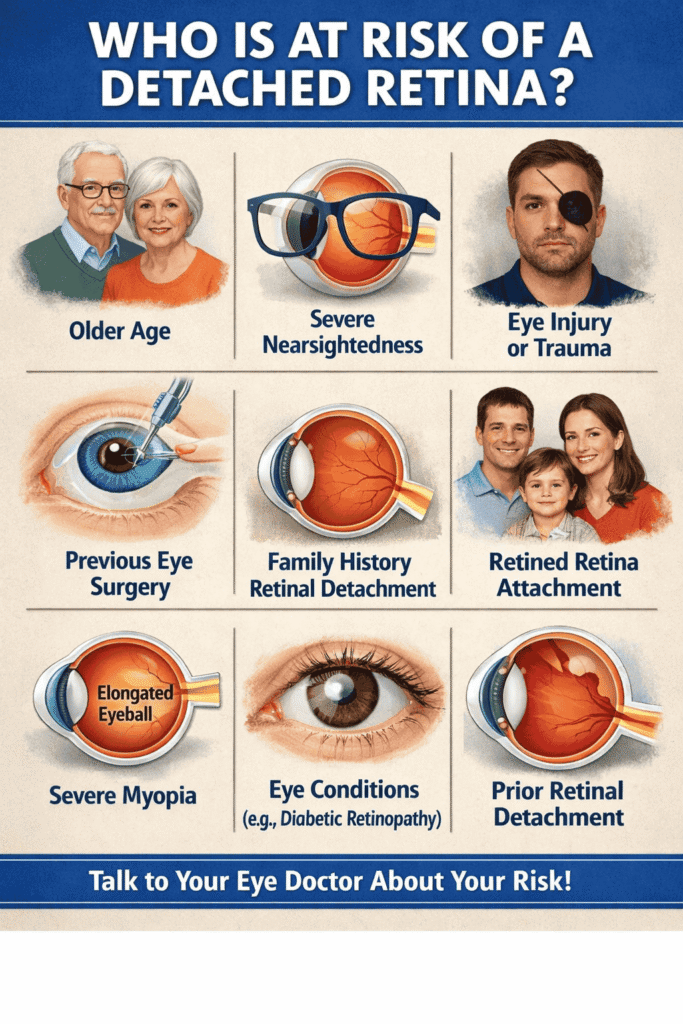
Preexisting medical conditions and family history of the patient as well as medical conditions that are preexisting are among the numerous risks for retinal detachment. I’m in high danger due to a variety of factors. It causes me to be anxious.
Any person can suffer from retinal detachment. It is an illness in which the tissue layer at the rear of the eye starts falling out of the retina.
Certain people are at a risk that is higher riskTrusted SourceTrusted source of having a detangled retina. The risk factors could be related to family history, medical conditions, or becoming older.
Common risk factors
National Eye Institute’s National Eye InstituteTrusted SourceTrusted Source provides the most common risk factors that can cause retinal detached:
- you or a close family member has suffered from an anterior retinal detachment
- eye injury that is serious that is serious, like eye injuries resulting from the weight of lifting
- eye surgery
As you get older the chance of developing a specific kind retinal tear risesTrusted SourceTrusted Source too.
More: Discover more the signs and symptoms, as well as the process of retinal detachment.
Family family history
Everyone can suffer from retinal detachment. However, those with relatives who have experienced this condition are at a higher risk.
First-degree relatives of those who’ve suffered from a detached retina are particularly at risk.
A 2023 review of research refers to older, well-established family studies that demonstrated the way in which one kind of retinal detachment could be found within families. It also revealed that life-long risk increases when a relative of the first degree has the retinal detached.
Other health issues
Certain eye-related conditions and medical conditions can increase your chances of retinal detachment. They comprise Trusted SourceTrusted Source:
- extreme nearsightedness
- age-related macular degeneration (AMD)
- Eye surgery, for instance to treat cataracts
- diabetic retinopathy
- diabetes-related macular edema
- posterior vitreous distancing occurs when the gel-like fluid that is located in the middle of your eye disengages from the retina
- Other eye conditions, including Coats eye disease retinal separation as well as thinning and separation of the retina
It is vital to detect early
It is noted that the American Academy of Ophthalmology (AAO) guidelines for clinical practice emphasize the importance of early identification as essential to identifying as well as treating retinal detached in order to keep from losing vision.
Based on these guidelines that the AAO states that doctors must be able to inform people who are at greatest vulnerable to developing symptoms of retinal detachment. They should also immediately seek medical attention when any of these symptoms are present. These signs could include:
- Eye floating
- sudden flashes
- an obscured shadow or curtain that stretches across your vision
Having regular eye exams as well as regular fundus exams with an eye specialist or retina specialist can help you keep an eye on the retina for any signs of a developing retinal tear or detached retina.
At my own risk
There are a variety of risk factors that can lead to retinal detachment are present in my daily life and this is what makes me very anxious.
Eye diseases, diabetes and genetics
My long-term Type 1 Diabetes is a constant aspect in everything that concerns my health. The diagnosis was made as a young person around four years ago. My diabetes was never properly controlled in my early years, and retinopathy later became an issue.
I’ve had numerous injections and laser treatments in the past few years.
In addition I’ve been diagnosed with the glaucoma condition and diabetic macular edema and both could make me susceptible to retinal detachment further. Also, there’s a chance of developing cataracts due to the maternal grandparents of my mother (the latter also suffers in T1D from childhood, and the diabetic condition known as diabetic retinopathy).
In other words, keeping all of the previously mentioned risk factors in mind, I am already at higher risk of developing them due to my own health, and also what’s likely to be in my genes.
I’m also nearsighted and have been throughout my entire life. Now that I’m in my 40s and older I’m at a point that my chance of developing retinal detachment is much more likely.
Family history and the detachment of the ear.
In addition the dad’s side has the family history of retinal detachment.
My uncle’s father suffered from detached retinas during his late 50s. The retina was discovered and treated quickly and he regained full vision, without any issues.
In his late 50s my father suddenly suffered a retina detachment. He noticed his central vision wasn’t as clear when he drove out of the state for an office conference. He waited a few days after returning to his home, and then eye floaters and other signs started to be a concern.
The person who contacted him prompted him to immediately consult his eye doctor. The doctor immediately referred him for an eye surgeon, who informed him that waiting too long could have resulted in loss of vision.
Doctors carried out pneumatic retinopexy surgery. This is similar to the procedure my uncle underwent to fix his damaged retina. This was done in an eye surgeon’s clinic at the medical center. The doctor injected a tiny air bubble inside the eye in order to push it back in its place. Then, they made use of a laser to repair any holes or tears that may have formed inside the retina.
After that, my dad had to lie down on his back and keep his eyes upwards for several days in order to stop an air bubble in place. He said he could see the bubble of air in his vision from the side and then it vanished.
There is no flying, golfing, lawn mowing, or other intense actions while the eye heals.
He put on an eye patch for a few days, playing with it, pretending to be a pirate. (“AAAARRG!”)
My father was diagnosed having just about 60% of his vision his eye and his depth perception was permanently impaired. It’s believed to be because waiting too long for the medical emergency treatment.
With these risks to consider, I’m aware of possible retina detachments that could be a reality in my life in the near future.
In all likelihood, any time it could be any time. This is especially true because it is the case for a lot of people including my uncle and dad.
More: Learn more about repair options for retinal detachment.
Steps to follow
Here are a few ways that those who are at greatest for retinal detachment could do to avoid it and to ensure that they receive prompt treatment as soon as they can in the event that it develops:
Get regular eye exams
It’s a regular element of my treatment plan. I’m currently seeing a retina specialist every few months, whether for a diabetes-related exam as well as reviewing my prescriptions for eyeglasses or for treatment for retinopathy. My retina doctor is well aware of my risk for retinal detachment and has it on her radar in her role as a doctor.
Be on the lookout for signs
This is a more challenging issue as I already have many of these symptoms that are related to eye problems or my general health.
It’s all about being mindful and understanding the potential risk. My dad, nor my uncle suffered from diabetes or the complications it brings into their health, so their symptoms could be more apparent. This is just another aspect I need to be on top of.
Keep on top of management
Maintaining my T1D and glaucoma management is an important item on my prevention of retinal detachment checklist consisting of Two drops for glaucoma daily and taking all the steps I can to maintain my blood sugar levels within the the range of my target as I can.
The main takeaway
Retinal detachment is considered a medical emergency. It requires immediate medical attention or surgery. It is essential to detect it early in the process of the prevention of permanent loss.
The most vulnerable people are those who have experienced or been a close family member who suffered from a retinal detachment. Other risk factors include eye health problems such as the glaucoma or cataracts and other medical conditions like diabetes.
Mike Hoskins is an editor at Healthline. For the past decade, he served as the managing editor of DiabetesMine and also tapped into his experience having the type one diabetes from his childhood. Mike has over 25 years of experience in journalism at weekly, daily as well as special print and digital media publications, which includes his own diabetes-related blog and advocacy.